

Let’s get something straight: I don’t like Apple. I’m no Steve Jobs groupie.
If anything, I side with Louis Rossmann tearing down their right-to-repair stranglehold — because real ownership means you should be able to fix what you bought, not beg a Genius Bar to unglue a battery.
But here’s the uncomfortable truth: Steve Jobs had the right attitude about design. His most cutting line still holds —
“People don’t know what they want until you show it to them.”
He didn’t ask.
He didn’t form a committee.
He told you what the future looked like, and then he shipped it.
Contrast that with today’s brands, where design has been downgraded to a hostage negotiation. Instead of vision, you get a string of PowerPoints. Instead of rules, you get “insights.” Committees gather, surveys circulate, consultants bill their hours, and out the other end comes something so focus-grouped it could be anyone’s.
That’s the problem.
Committees don’t build icons. They build camels.
This is what happens when executives and designers don’t actually understand their customers. They compensate with polling, with “community input,” with listening sessions. And what do they get? A Frankenstein compromise: bland enough to not offend anyone, generic enough to be forgotten by everyone.
Design by committee isn’t caution.
It’s cowardice dressed up as consensus.
Cultural Amnesia vs. Brand Memory
Brands are like cultures: they survive through memory. They keep a set of house rules — aesthetics, codes, rituals — and evolve them over time. That’s how Chanel under Karl Lagerfeld modernized Coco’s grammar without ever erasing it. That’s how Nintendo can keep Mario in the same red hat and blue overalls for decades without anyone calling him outdated.
But when design is handed to committees, memory goes out the window. Instead of evolution, you get erasure. The brand forgets what made it itself, and in the scramble to be “now,” it burns its own archive.
This is cultural amnesia disguised as innovation.
The irony is that brands talk about “heritage” all the time. They put dates on their packaging. They run nostalgic ad campaigns. They tell you they’ve been around since 1887. But when it comes to actual design decisions, they toss out their identity like it’s seasonal packaging.
Anthropologists have a word for this: ethnogenesis — the process by which new cultures emerge, usually by remixing or reinterpreting existing traditions. But here’s the catch: ethnogenesis only works when it’s organic, when people live it and pass it on. When it’s imposed from the top down — when executives strip out heritage to chase universality — you don’t get a new identity.
You get homogenization.
That’s the real danger of design by committee: it’s not just boring, it’s forgetful. It doesn’t build memory — it deletes it. And when you erase your own codes, you stop being a culture at all. You get absorbed into something blander, safer. Forget your markers, and you become featureless corporate soup.
You become slop.
The kind served lukewarm, with a plastic spoon, in a cafeteria no one remembers.
Case Studies of Memory Loss
Take Jaguar. For decades, the brand meant British elegance welded to racing pedigree — the kind of logo you could imagine glinting on a bonnet screaming down Le Mans. Then the rebrand hit. Out went dimensionality, heritage, and muscle. In came flat, digital, “me-too” luxury branding. Instead of a prowling cat, Jaguar became Generic Premium Car Brand #5, indistinguishable from Lexus or Audi at thumbnail size.
There was a hype video — slick models, surreal backdrops, slogans like “Copy Nothing” and “Break Moulds”, yet no actual car in sight. Critics and fans alike balked. Elon Musk’s pithy response? “Do you sell cars?”
Consumer sentiment was far from unanimous. In a sample survey, about 42.7% reacted negatively, calling the campaign confusing or “woke,” while just 30.9% responded positively — appreciating its youthful vibes but hesitating over the glow of the campaign.
Then came the fallout.
In April 2025, European sales cratered by 97.5%, mirroring a global plunge of 85% compared to 2018, concurrent with Jaguar’s fraught identity pivot. CEO Adrian Mardell, who championed the rebrand, left the company amid the backlash.
Boy, that escalated quickly.
Now swing over to Cracker Barrel — a brand literally built on nostalgia. Their logo, a sepia-toned slice of Americana, became the subject of a viral conspiracy theory: people thought the “K” hid a whip. Instead of laughing it off, or doubling down on its own heritage, the company went defensive. Suddenly, the brand wasn’t a cultural anchor. It was a symbol of fragility. A company so rattled by internet outrage it nearly apologized for its own name.
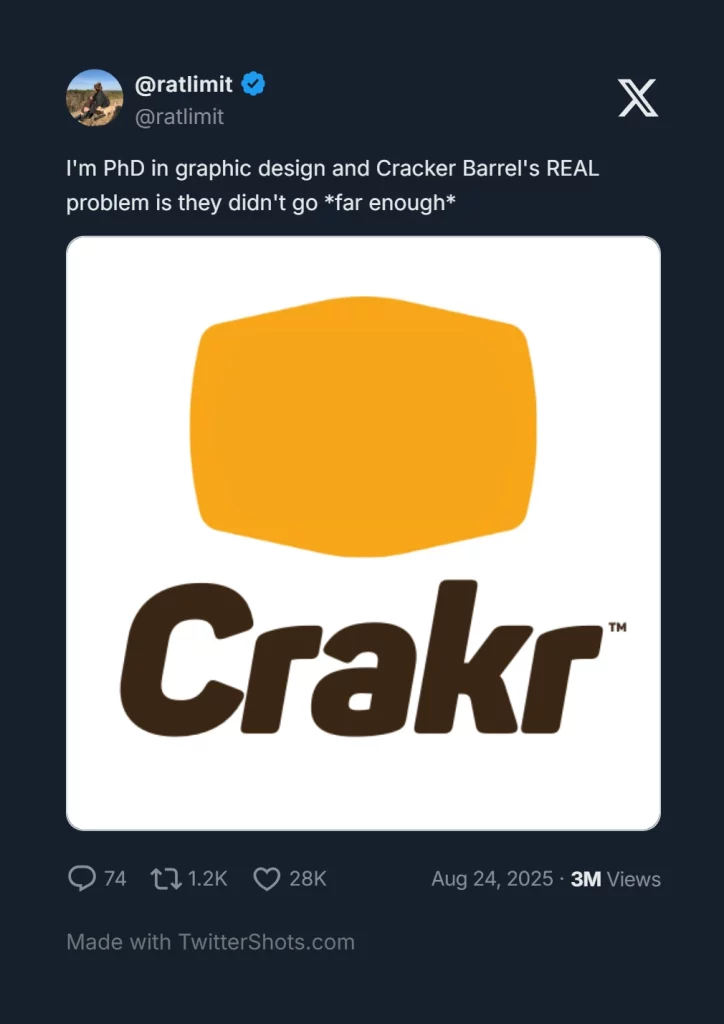
By mid-August, social media erupted. Critics — including former President Trump — scolded Cracker Barrel via public posts, demanding a return to tradition. “They got a Billion Dollars worth of free publicity,” Trump declared. The market chimed in too. Cracker Barrel’s shares plunged nearly 7–15%, shedding over $100 million in valuation almost overnight.
The brand folded. Within days, Cracker Barrel backpedalled, reinstating “Uncle Herschel” and publicly thanking customers for “showing us how deeply people care.” The stock miraculously recovered nearly all its losses.
My point being, this is what happens when you sand away specificity. Once an icon loses its confidence, it becomes a Rorschach test for whatever the algorithm serves up that week.
Which brings us to the real corporate bloodbath, the butchering of childhood nostalgia that’s making the rounds on X.
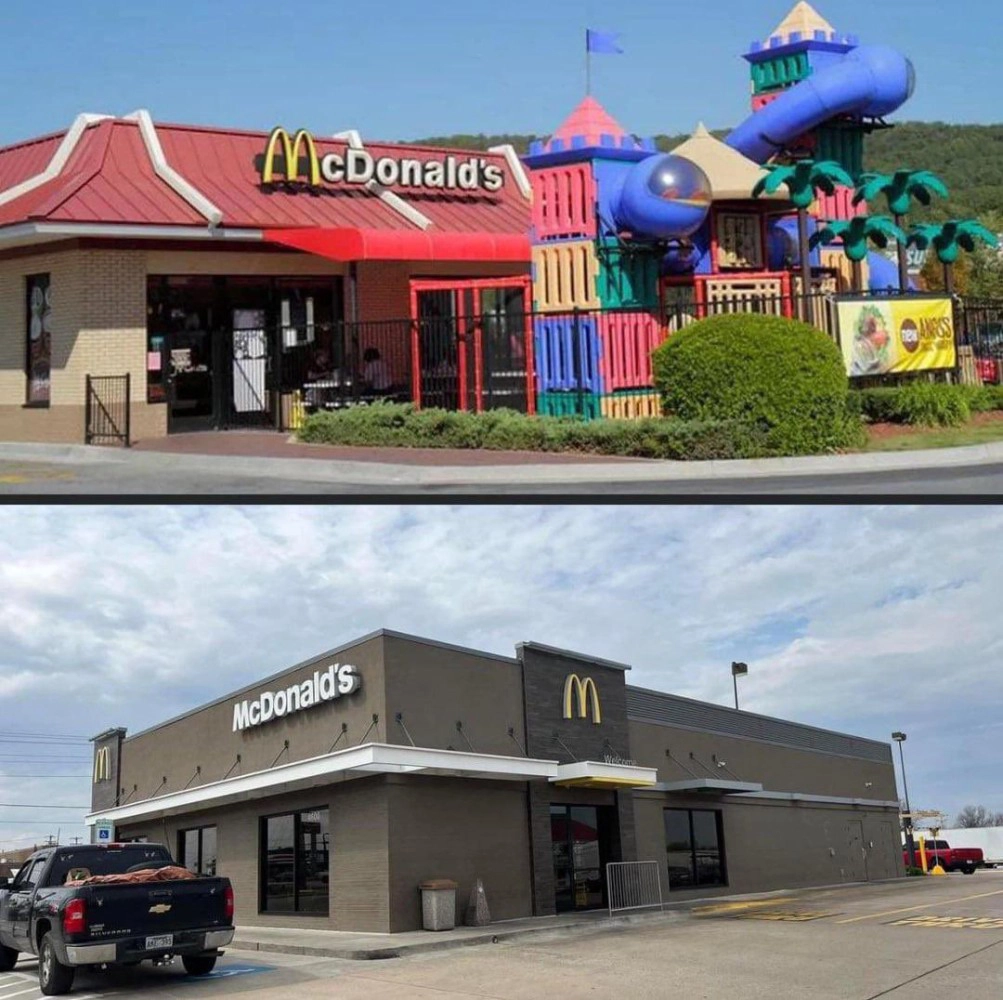
Once upon a time, McDonald’s wasn’t just a fast-food joint. It was ritual. The red roofs, the golden arches, the playgrounds, the plastic Ronald statues grinning in the corner, the Hamburglar and Grimace running side quests in kids’ imaginations. McDonald’s wasn’t selling just calories — it was selling family identity.
Now? Walk into a McDonald’s and you could be in a WeWork lobby or an airport terminal. The red roofs are gone. The play areas have been bulldozed. Ronald McDonald seems to have been quietly taken out back and shot.
The Hamburglar?
Probably pivoted to a career in crypto scams.
It’s all gray panels, digital kiosks, and “efficiency.” A placeless, joyless experience designed not for families but for throughput. In chasing sleek universality, McDonald’s erased its own mythos. It traded Americana whimsy for corporate blandness, and ended up indistinguishable from any other global chain trying to look “modern.”
They didn’t modernize. They sterilized.
And the smell of fries can’t mask the scent of corporate beige.
This is what design by committee does: it doesn’t just neuter heritage, it neuters soul. Jaguar lost its growl. Cracker Barrel lost its confidence. McDonald’s lost its childhood.
And all of them ended up looking disgustingly tame.
Investor Logic vs. Consumer Logic
Here’s a dirty little secret: design can’t be universal.
Every brand has a core demographic, the people who show up, spend money, and keep the lights on. That’s the group you build for. That’s your loyalty base.
But investors don’t see tribes. They see total addressable markets. To them, every brand is a funnel that isn’t wide enough yet. Why stop at the audience you actually resonate with when you could — in theory — resonate with everyone?
And that’s where it breaks.
Because in trying to be “for everyone,” you end up being for no one. The quirks, the specificity, the edges that made people love you get sanded down into a corporate slurry. Suddenly your “heritage-rich” car looks like decidedly safe and inoffensive. Your family restaurant looks like an accountant’s office. Your jeans ad looks like a company uniform manual.
In chasing universality, you don’t just erase identity, you burn loyalty.
Investors call it scalability. Consumers call it betrayal.
The irony? By trying to capture everyone, you end up losing the most important someone who was paying your bills in the first place.
Great brands know who they’re for and pull by-standers into their orbit by charisma.
Weak brands chase people down the street asking them to please take their flyer.
When Musk Vibes with An Idea
In 2021, buried in the chaos of Twitter replies, someone half-jokingly suggested that SpaceX’s Starbase could use a retro-futurist diner — roller skates, chrome booths, neon piping, the full Jetsons-meets-50s Americana fantasy.
Musk didn’t ignore it.
Love him or loathe him, he didn’t ask for a focus group, he spotted an idea in the chaos and built it.
By 2023, Tesla confirmed plans to build not just one, but a global chain of futuristic diners, with Starbase earmarked as a flagship site. It was camp. It was kitsch. It was unapologetically specific — the antithesis of “generic slop.”
And that’s what makes it fascinating.
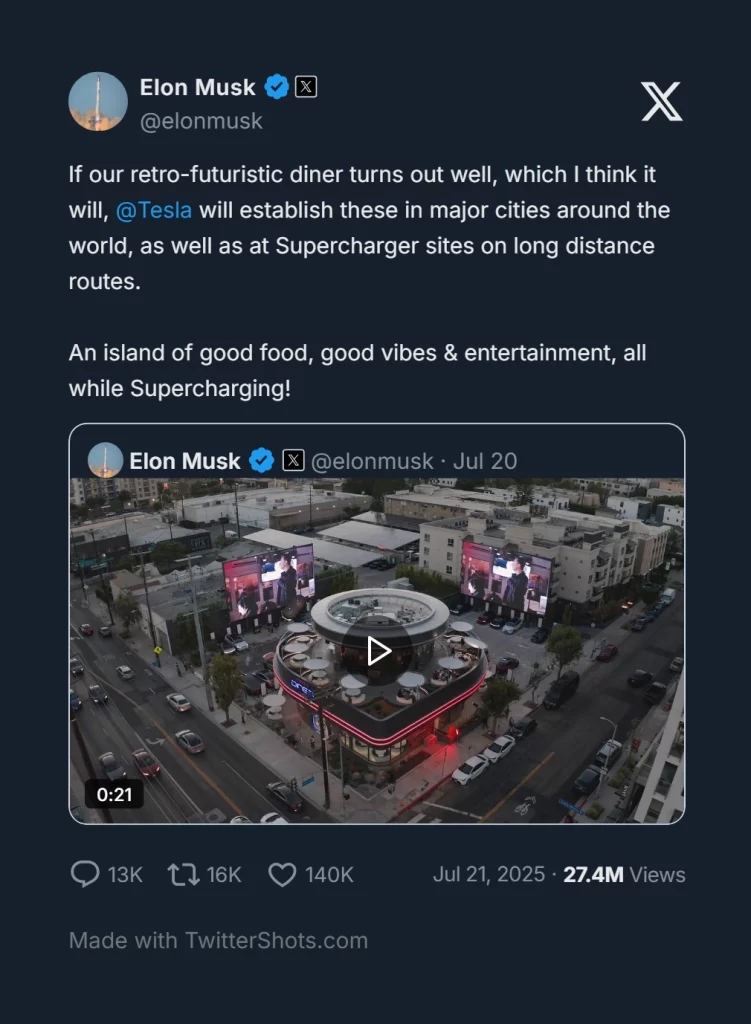
The diner concept isn’t about food. It’s about memory. It’s about creating a place where nostalgia collides with futurism, where design isn’t sanded down for universal approval but cranked up to eleven. The very fact it could expand globally suggests something obvious: people are starved for design with character.
The point isn’t that every company should slap neon on their storefront. It’s that the future doesn’t belong to committees optimizing for app icons. It belongs to those willing to risk eccentricity, to tap cultural memory, to make something that might be laughed at — but never ignored.
If a diner at a rocket base can spark a global rollout, then the lesson is simple:
Vision scales, consensus doesn’t.
The Camel Problem
Design by committee will always give us camels — safe, inoffensive, and utterly forgettable. But history doesn’t remember camels. It remembers stallions, rockets, and, yes, diners with neon tubing.
The future won’t be built by PowerPoints or focus groups smoothing every edge. It’ll be built by people — and brands — willing to risk offense for the sake of character.
Because blandness doesn’t scale. Specificity does.
So here’s the lesson: Stop asking the crowd to tell you who you are. Stop sanding down the quirks that made you matter in the first place.
Build with vision. Build with memory. And maybe — just maybe — build something bold enough to be mocked.
Put your ass on the line and find the courage to step on some toes.