

Picture this: you’re Ross Geller, screaming “PIVOT!” as you wedge a sofa up a staircase. That sofa? It’s your carefully built, SEO-optimized website. The staircase? The shifting terrain of how users actually find information. Spoiler: nobody’s reaching the top.
Content creators, brands, and platforms are all crammed into a narrow stairwell, blindly trying to shift strategy as generative AI kicks the legs out from under the last decade of digital norms.
The problem? We’ve been here before.
Back in the early 2000s, websites were the thing. Everyone needed one. Neopets was slinging plushies with code cards in Claire’s Accessories just to drive traffic back to their platform — gamified, physical marketing designed to lure you online. Getting users to a site was the challenge, and the reward was eyeballs on ads, page views, and data collection.
Fast-forward to today, and websites aren’t dead — they’re just kind of… irrelevant. Social media became the middleman. Now, the middleman is being replaced. Chat AIs are eating search, swallowing traffic, and in the process, pulling the rug out from under an entire generation of online strategy.
Why Google something when ChatGPT will just tell you the answer? Why visit a webpage when the AI already read it, scraped it, and distilled it? The SEO arms race has hit a wall, and the wall is called: you’re not needed anymore.
That’s where the pivot panic begins.
Everything’s in a Box (And It’s Time to Get Out of It)

There was a time when websites were weird. Not bad weird — good weird. Gloriously chaotic. Sparkling mouse trails, autoplay MIDI tracks, aggressively tiled backgrounds, and buttons that looked like they were made in MS Paint by someone high on Capri Sun and unregulated creativity. It was the wild west of digital design, and we loved it.
That era — the early 2000s — has since been canonised into a nostalgia-fuelled aesthetic known as Vaporwave: glitchy fonts, broken geometry, and the haunted memory of Windows XP. But beyond the memes and moodboards, vaporwave represents something deeper — a longing for a time when the internet felt human, not harvested.
Because somewhere along the way, websites stopped being destinations and became templates. From independent blogs to corporate landing pages, everything’s now tucked neatly into sanitised boxes. Navigation bars, hero images, cookie banners, white space, repeat. Scroll, click, bounce. The architecture is less designed and more resigned — tailored for SEO, not for soul.
This shift was driven by survival. Search engine algorithms dictated design. Content needed to be crawlable, indexable, keyword-dense, and mobile-responsive. Creativity didn’t stand a chance. In the name of optimisation, we engineered the joy out of the web.
And now? It might be time to think outside the box — literally. Because as AI begins delivering answers directly, bypassing these very websites altogether, the formulaic structure we’ve relied on for discoverability stops mattering. The box isn’t just boring. It’s obsolete.
If you know where to look, you’ll find a curious thing is happening: the spirit of GeoCities — the internet’s original patchwork quilt of chaos — is quietly making a comeback on platforms like Neocities. People are building wild, personal, hand-coded sites that celebrate the weird and the wonderful, rejecting the cookie-cutter in favour of handcrafted quirks. Maybe, just maybe, we’re due for a rebirth of digital DIY culture — but this time with a sharper edge.
From Claire’s Accessories to Neopets: A History Lesson
Remember when Neopets sold plushies with in-game codes in Claire’s Accessories?
Physical-world bribes to lure people online.
We may need to go back to thinking that creatively just to get someone to visit a site.
Below is an original promotional graphic from Neopets.com, circa 2002. This wasn’t just marketing—it was the blueprint for what would become one of the earliest, most effective examples of cross-channel UX design.
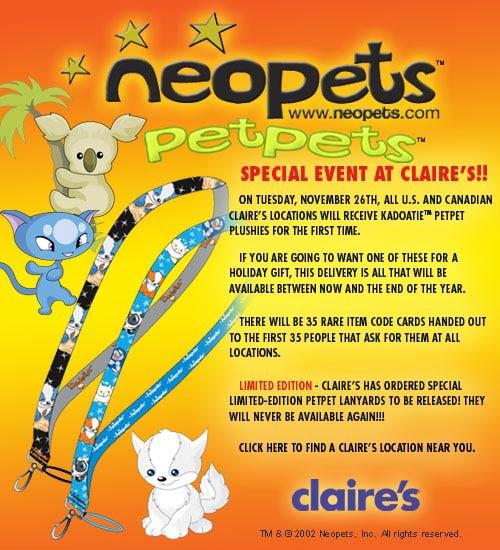
What made this mechanic so successful wasn’t just the novelty—it was the seamless UX bridge between physical and digital. A kid picks up a plush toy in a store (tactile reward), and that toy comes with a clear, specific incentive: enter this code online to get something rare, exclusive, and brag-worthy in the Neopets universe. The steps were easy, the reward immediate, and the motivation deeply personal.
This wasn’t a passive ad—it was gamified onboarding long before that term entered product strategy decks. The physical plushie became a portal. The user’s journey didn’t start on the website. It started at the mall.
It’s that kind of multi-touchpoint experience—blending emotion, reward, and low-friction onboarding—that current digital spaces are sorely lacking. Incentivizing users to go beyond the infinite scroll will require rethinking the entire funnel—because SEO and banner ads are no longer enough.
If you want people to visit a site in the age of AI-powered instant answers, you might need to start with something a little weirder… like a toy in a Claire’s bin that unlocks a treasure chest in your next digital adventure.
Welcome to Adpocalypse 2.0: The Feed Is Full — and So Are Your Scrollers
There was a time—long ago, before the algorithm broke its last remaining bone—when your website could exist in peace. People would Google things. You’d show up. Maybe they’d click.
That time is gone.
Now your website is just one item in a chaotic buffet of paid placements, product dumps, auto-playing reels, and user comments saying “algorithm brought me here” like it’s a seance.
Let’s break down the real reason no one is clicking your lovingly-coded linktree anymore:
1. Everyone Bought Ads—and Built a Wall
Websites used to fight for visibility with relevance. Now they fight with money.
- In 2024, social media ad spend overtook search, hitting $247 billion globally and still climbing.
- Platforms like Facebook have 10–15% ad saturation in the average feed, and yes, people are noticing: 67% of users report feeling overwhelmed by the number of ads in their feed — up from 59% in 2023.
That fatigue isn’t a vibe. It’s the natural outcome of every brand, influencer, and startup carpet-bombing attention spans with slightly-zoomed-in video ads. Congratulations: your site is now another glimmer in the attention desert.
2. Organic Reach Is a Graveyard Now
Search engines used to be democratic(ish). Now, if you’re not paying, you’re not showing.
- Your website isn’t ranking unless you’ve mastered not just SEO, but Search Engine Paid Ad Optimization—a dark art so bleak it makes PPC specialists drink from ergonomic mugs that say “CTR is my love language.”
- Meanwhile, the platforms that send you traffic—Google, Meta, TikTok—are all running a quiet war of attrition against organic links. They’re replacing outbound results with ads, affiliate links, and AI answers.
Your carefully optimized blog post? Derailed by a carousel ad for teeth whitening strips and a “People Also Ask” box that answers everything without ever visiting your site.
3. TikTok Doesn’t Need to Show As Many Ads—Because You’ll Watch Anyway
Here’s the final insult: some platforms don’t even have to drown you in ads because you’re already addicted.
- TikTok shows fewer ads by percentage than Meta—not because they’re generous, but because they get more engagement per view. Traffic campaigns on TikTok achieve a 4.93% click-through rate, compared to 2.54% on Meta, translating to nearly double the engagement per impression.
- Despite near-identical CPMs ($0.32 on TikTok vs. $0.33 on Meta), each click on TikTok costs just $0.01, compared to $0.05 on Meta, enabling scaled testing at minimal spend.
So now brands are chasing reach on TikTok. And you know what they’re linking to? Not your website. They’re linking to… more TikToks. Or maybe a Linktree. Or a funnel. Anything but a homepage.
So What Happens Now?
Most websites aren’t dying because they’re bad. They’re dying because the modern web no longer has room for passive discovery.
If people don’t already know you, they won’t find you. And if they do find you, it’s because you paid six figures for 14 seconds of attention—and lost half of that to load time.
So unless your site offers:
- something interactive,
- something hyper-specific,
- or something gloriously unhinged—
…it will likely vanish under the algorithm’s weight.
Like a flyer stapled to a tree in a city that hasn’t had foot traffic since 2016.
Chat AI as the New Discovery Layer
Search used to be the gateway. Now it’s the gatekeeper.
Chat-based AI tools aren’t just helping people search — they’re searching, filtering, comparing, summarizing, and translating for them. The user no longer clicks through websites. The AI does — and it doesn’t always knock. If you’re not in the dataset, you’re invisible.
And if you are? You’re probably just background noise.
Because here’s the truth no one wants to say out loud: Template-based websites are deader than dead.
To stay ahead of ChatGPT and AI-powered alternatives, Google has embedded Gemini right into Search with features like “AI Mode” and “AI Overviews”—which summarize your search for you. That’s their play to shift from link-based search to AI chat-based retrieval.
But it’s not going smoothly:
- Usage numbers are lackluster: Gemini holds only about 13.5% share of U.S. chatbot traffic, vs ChatGPT’s ~60%. That’s a huge gap to bridge.
- There’s growing skepticism: users complain Gemini is inaccurate, clunky, and even actively sabotaging the legacy Google Assistant.
- Trust is eroding fast: some trials have produced bizarre hallucinations that went viral—like advice to “eat rocks” or “put glue on pizza”.
So what comes next?
If you want to be remembered, you need to become memorable. If you want to survive, you have to matter. And the only way to matter in this new discovery layer is to make something that cannot be templated, scraped, or summarized.
Websites, if they are to have a purpose again, must evolve.
Less brochure. More art installation.
Welcome back, 1999 — but this time, the weirdness is intentional. This time, we’re not just making homepages. We’re making haunted houses you have to walk through.
Strange, defiant, beautiful little worlds that can’t be flattened by a summary box.
Not because they’re inefficient — but because they’re alive.