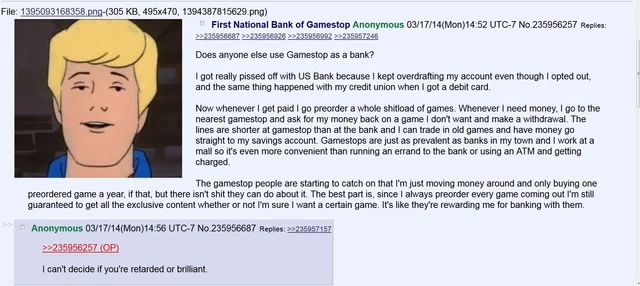
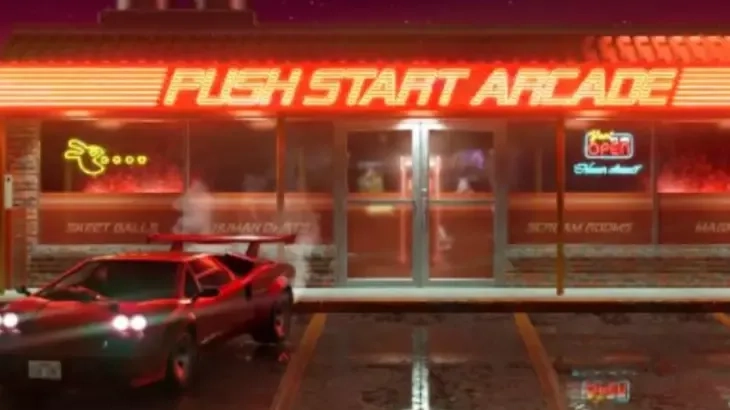
A cryptic teaser. A synthwave logo. The words PUSH START ARCADE blink into existence with zero explanation — just a flash of neon nonsense like “Skeet Balls,” “Human Debts,” and “Magnets.” And then, in all caps: COMING SOON.
That’s it.
That’s the post.
It came from the official GameStop NFT X account, which hasn’t said a word since. And somehow, this was enough to spark a miniature financial fever dream.
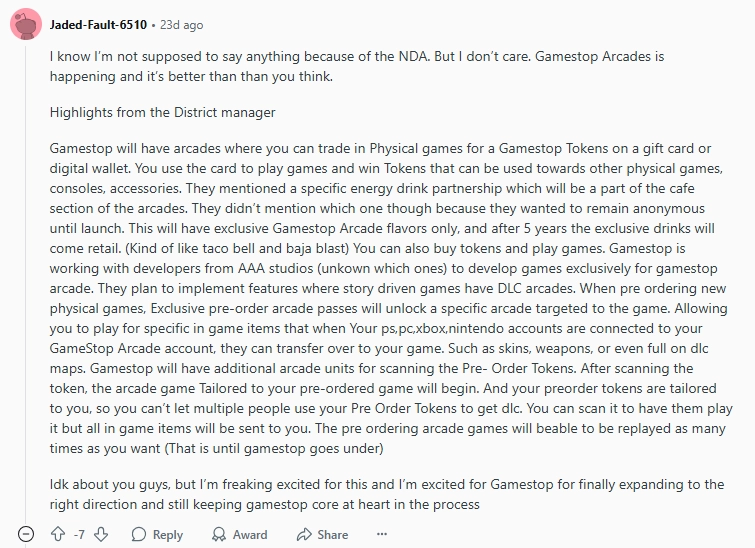
Reddit immediately lit up with speculation, investors started whispering about “premium vault experiences,” and even former employees on r/GameStop — notoriously hardened by years of internal chaos — were left blinking into the void.
“This sounds like the stupidest shit ever, and the worst part is I’m not sure if you’re making it up or GS is actually dumb enough to do it.”
And listen — I get it.
You see “arcade” and “GameStop” in the same sentence and your brain flattens itself like a pancake. But here’s the thing: the weirdest part of this story isn’t that people believed it — it’s that it might actually be true.
Because buried beneath all the memes and unhinged Reddit theorizing was a possible signal. One employee spotted a new SKU in GameStop’s point‑of‑sale system: something tied to hourly table rentals. Somewhere else, a user decoded the arcade promo and matched it to PSA-graded trading cards. A few more joined dots back to NFTs, gamified apps, or location-based collectibles.
Some called it a distraction. Others saw a pivot. But what nobody could ignore was the pattern:
GameStop might be reinventing itself again. And this time, the battleground is not the stock price. It’s physical space.
Let’s break it down.
History Doesn’t Repeat Itself, But It Does Rhyme
New technology never arrives directly into our living rooms. It shows up first in public — noisy, flashy, and barely functional — until the demand becomes so loud, we have no choice but to bring it home.
Take arcades.
In the 1970s and 80s, these dimly lit temples of joystick worship were how gaming first entered public consciousness. Kids didn’t own Asteroids machines — they lined up in smoky corners of pizza joints with crumpled dollar bills, pumping quarters into cabinets they didn’t understand but couldn’t stop playing. The arcade was the on-ramp to a digital world. And soon, people wanted that world at home.
So came the consoles: Atari, NES, Sega. But make no mistake — they were expensive. The average household didn’t immediately have the budget for a full console setup, much less a library of games. It took years. The public space softened the financial blow. It normalized the tech, created culture around it, and only then did the home invasion begin.
We saw it again in the late 90s and early 2000s with the rise of the internet. Back then, you didn’t “have” internet — you went to the internet. Libraries, universities, and dingy cafes lit by CRT monitors were the first points of contact. You paid by the hour and tried to sneak in LimeWire downloads while pretending to study. Only once people saw how integral it was for communication, gaming, work, everything, did they make the leap to home routers and Wi-Fi.
Access always precedes ownership. Public space is where new technology becomes socially and financially accessible. It’s cheaper to rent a few hours of future than to buy it outright. The business model works by creating necessity, and then normalizing the idea that you need this in your life.
Which brings us back to arcades — and why they didn’t die, they mutated.
In the west, we treat arcades as a nostalgia gimmick: retrofitted bars with Donkey Kong machines and warm beer. But in Asia, they never left — they evolved. In South Korea and parts of China, PC bangs and modern internet cafés became the new arcades: high-end, high-speed, ultra-accessible gaming hubs. You rent time on state-of-the-art PCs with fiber optic connections and surround sound. You play MMORPGs, run tournaments, and socialize. It’s cheap, fast, and communal — a public utility for digital life.
In that sense, a physical space dedicated to gaming and collectibles isn’t backwards. It’s cyclical. It follows the same pattern we’ve seen for fifty years: introduce the tech in a low-barrier environment, create social pressure to participate, and then wait for the at-home adoption curve to explode.
Maybe GameStop isn’t betting on the past. Maybe it’s quietly following the blueprint of the future — a future that, in some countries, has already arrived.
Why GameStop Could Actually Win the Arcade Comeback
If you’re wondering how a meme-stock legend ends up in XR arcades—in stores—this is the section where it clicks. GameStop isn’t just a retailer anymore. It’s a cultural institution with strategic reach.
A Fanbase That Feels Like Ownership
The 2021 short squeeze wasn’t just Wall Street chaos—it was a cultural movement. Reddit users organized, held their nerve, and lifted GME from sub-$20 to nearly $500 in days. That wave was about more than profit. It was identity. People still say they own their shares because they see GameStop as theirs—a kind of public utility they rescued from oblivion. That loyalty isn’t abstract. It’s tribal. It’s real consumer currency.
“A literally f—ton of crayon eaters … Only company with more loyalty is Apple.”
Ryan Cohen’s Tactical Pivot & Cash Fortress
Enter Ryan Cohen, co-founder of Chewy, who became GameStop’s chair in mid‑2021. He’s quietly transformed the company — cutting underperforming stores, trimming costs, and accumulating a mountain of cash. As of May 2025, estimates showed $6.4B of cash and marketable securities, and Cohen told CNBC last week that the tally has risen to around $9B. That financial runway gives the company strategic optionality: it can invest in new hardware, experiential retail, or buy proprietary tech without risk. Investors are now watching every whisper — because Cohen could move fast, but no one knows where he’s pointing.
Staff, Infrastructure, Community — All Aligned
GameStop’s 4000+ stores aren’t just real estate — they’re cultural hubs staffed by gamers who know the landscape. You’re not hiring consultants to explain why people love co-op dungeon crawlers — you’re promoting the guy who already runs tournaments after hours. These aren’t generic mall employees; they’re embedded in the community. That lowers the activation cost of something like an arcade reboot. The vibe is already there.
Stores as Living Spaces, Not Static Showcases
Gamers don’t just walk into GameStop — they hang out. You see it during mood dips, console launches, or community events. Think early Blockbuster gatherings — now powered by nostalgia and impulse buy energy. Rather than being just a pickup point for online orders, stores could revive retro game cabinets, limited drops, and in-store-only play sessions. That gives people meaningful reasons to return beyond buying the next edition digitally. It taps into something deeper: spontaneity, discovery, and social impulse.
“Micro-Treat” Spending Works in Downturns
The arcade model thrives not in boom times, but during belt-tightening. In recessions, people cut back on big-ticket items—but not on small thrills. A $6 pizza slice, a $10 nostalgia run on a cabinet, or a $5 collectible sticker—these feel justifiable even when wallets are tight. That “treat yourself” economy is recession-resistant. Arcades tap that exact impulse.
That’s the real secret: in a downturn, people don’t stop spending—they just spend differently. And arcades, especially the modern kind, are built for exactly that shift.
The Recession‑Era Economics of Arcades
If you think people stop spending during a recession, think again. They just get smarter about where they spend. And arcades—especially updated versions—are perfectly built for that reality.
We Are in a Recession (Even If No One Says It Loudly)
Forget boomlines and buzzwords. We’re living in a high inflation, stagnant wage, and underemployment reality—especially for Gen Z. Deloitte surveyed 22,000 Gen Z and millennial respondents across 44 countries, and found that rising cost of living was their #1 concern—outranking job loss, climate change, and mental health. In the U.S. and UK, Gen Zers face record debt and housing costs, with many doubting whether they’ll ever own a home.
That squeeze leads to behavioral changes: Gen Z is far more likely than other cohorts to run out of money each month—nearly half of them, according to a Step survey. Comforts are few and far between. Yet many still choose to treat themselves—just in micro doses. Even big-ticket entertainment is feeling the strain: Sony recently slashed its PlayStation 5 sales forecast by several million units, citing weaker-than-expected demand.
Small Luxuries Thrive in Lean Times
Behavioral economics shows that in downturns, people rein in big-ticket items but still seek affordable joy. That isn’t reckless spending—it’s strategic escapism. Whether it’s a mid-grade ice cream cone, a glossy lipstick, or a brief demo on a new game cabinet, these micro-treats provide reward without cost. According to Arta Finance, 38% of Gen Z are entering what’s been described as a modern “midlife crisis”—driven by financial insecurity, stress, and the need to feel something, anything, even briefly.
Arcades are tailor-made for that psychology. For a few dollars you can buy an experience that feels rich, communal, and guilt-free. It’s not about owning the game—it’s about feeling its highlight reel, social good and all.
The Loneliness Gap Meets Consumer Need
Gen Z is the loneliest generation in history. 8 in 10 Gen Z respondents say they’ve felt lonely in the past year — far above the rate for baby boomers. Yet, cheap places to gather? Those are disappearing. The death of the shopping mall, rising café prices, and shrinking public spaces mean fewer cozy corners for people to hang out in.
Arcades close the gap. They are semi-private, socially safe zones where you can play, pause, watch, and chat without needing a big budget. They aren’t substitute classrooms; they’re micro-lobby zones for real interaction. When one of the only places you can be in-person with other humans costs $5 and a level-up — people make time to go.
Gen Z’s Spend Patterns & Social Needs
Gen Z doesn’t just crave connection — they crave control in chaos. They feel pinch from pointless debt while longing for authenticity. Arcades fulfill both: they offer quick dopamine, live moments, and a superficial sense of mastery —all affordable. As living rooms shrink, mental health frays, and anxiety rises, people need somewhere to be seen, to sit, and to breathe.
Arcade economics work because they’re grounded in psychology:
- Low entry cost → no financial risk
- Tangible reward → an actual screen lighting up
- Social overlap → friends can spectate, chat, and compete
- Repeatability → $5 every week adds up, without guilt
Arcades thrive in downturns because they reframe spending — not as luxury, but as affordable, social necessity. That model isn’t new, and it’s not limited to the U.S. In Seoul, PC bangs offer high-speed gaming for the price of a coffee. In Tokyo, capsule arcades remain packed. In Lagos, gaming cafes serve as hybrid coworking spaces. Across the globe, low-cost entertainment hubs fill the void left by shuttered malls, unaffordable cafés, and digital isolation.
The modern arcade isn’t just recession-proof — it’s recession-born. And that financial logic could be the foundation for GameStop’s next act, especially as XR and experiential retail enter the frame.
Call It “Internet Cafés for XR” — The Missing Intro to Mass Adoption
Back in 2017, I was already banging the drum about the hygiene problem in XR. It seemed obvious: if we wanted shared headsets in arcades, museums, classrooms, or even office demos, we needed hardware that could be properly cleaned — fast, safely, and often. But instead of solving it, companies kept releasing new models with the same flaw.
It made no sense then.
And after a global pandemic? It’s downright baffling.
The industry still hasn’t cracked the problem of shared-use headsets — and it’s one of the reasons we’ve never had a real “try it first” phase for XR. Every other big tech shift had one:
- The early internet? You met it at school or the local library.
- Gaming? You played at a friend’s house or at the arcade.
- Even smartphones had a public trial period — everyone remembers borrowing someone’s iPhone to see what the fuss was about.
XR? We tried to skip straight to the living room.
It didn’t work.
In 2023, global XR headset shipments dropped 19% despite big launches like Meta Quest 3 and PlayStation VR2. Prices were too high, games too thin, and the public too unconvinced. In 2025, the market limps on — cautious consumers still aren’t biting.
The industry made a bold bet that people would unbox magic and just get it. But most didn’t. And without a critical mass of users, developers drifted away too. No players, no games. No games, no players.
No One Wants to Spend $300 Just to Try Something Weird
Over half of all surveyed consumers say price is the #1 reason they haven’t tried XR — and even a $300 headset feels risky when your phone and laptop already do everything you need.
There’s also a brutal truth no one wants to say out loud: no XR headset on the market right now is arcade-ready.
- The materials are too soft for heavy use.
- Shared padding gets gross fast. Sweat, makeup, and shared use make them hard to sanitize.
- Apple’s Vision Pro is arguably the most hygienic (removable washable components), but the $3,499 starting price and fragile curved display make it impractical for casual drop-ins — repairs run into thousands of dollars.
- Meta discontinued the Quest Pro in early 2025 amid underwhelming demand for a $1,000 enterprise headset.
- Motion sickness, poor fit, and short session tolerance still plague casual players.
The hardware can’t scale in public — and it’s not convincing in private. That’s a bottleneck.
What We Needed First Was the Equivalent of Internet Cafés
The missing piece wasn’t more pixels. It was place.
We needed physical spots where people could casually drop in, try XR on their terms, and decide for themselves whether the juice is worth the headset. Not a two-minute demo in store. A proper social, low-risk, low-cost introduction. Think: XR cafés. Immersion arcades. Public hardware, private portals.
The café era is where the magic usually begins. And we missed it.
GameStop Could Actually Build That
Forget the headset arms race. Forget chasing Apple.
GameStop could pull a power move by shifting XR adoption back into physical space. Here’s how:
- Proprietary, arcade-grade headsets: Built for durability and hygiene — easy to sanitize, replace, and disinfect.
- Optimized from day one: Developers build to one known platform, not ten. There’s no platform fragmentation — and GameStop can offer publisher exclusives based on real user behavior.
- Skip consumer sales (for now): Start with in-store trials and time-based sessions. Let people play before they pay.
- Monetize attention, not ownership: Sell experiences, not units. Think of it as XR-as-a-service, in-store.
- Transition path to ownership: If people like the experience, they may buy the home version later — but only once they’ve already internalized the content.
It’s the same playbook as the early gaming arcades — just updated for 2025.
Why It Works
- High sticker price → Small session fees, no up-front risk
- Fragmented hardware → One consistent GameStop headset
- Lack of consumer confidence → Try-before-you-buy, in-store
- Developer hesitation → Known platform + player base = lower risk
- Poor hygiene / wear → Custom-built, durable, swappable parts
This isn’t just a throwback to 90s arcades. It’s a re-introduction — one that could finally bridge the gap between XR hype and everyday use.
Insert Coin to Continue
For all the chaos, memes, and market whiplash, GameStop might be staring down one of the most surprisingly coherent comeback strategies in tech retail. Not by chasing trends, but by understanding how new technology actually spreads: slowly, socially, and in public.
This isn’t about nostalgia. It’s about infrastructure. We’ve seen this before, from coin-ops to internet cafés, from LAN parties to phone booths. Every major digital revolution needed a third place to get its footing. XR is no different. It won’t go mainstream in a vacuum-sealed headset box. It needs a proving ground.
GameStop, weirdly, might be the last place left that has the physical footprint, cultural capital, and user loyalty to pull it off. Not just as a place to buy the future — but to try it, feel it, and believe in it.
The neon teaser might have looked like a joke. But if even half of what’s been hinted at is true, then GameStop’s not playing around. It’s building the arcade of the 21st century — and in doing so, quietly rebooting the business of wonder.
So yeah — push start.
The next level might actually be worth playing.
(keep scrolling…)
(bonus level unlocked)
(cue analog VHS hiss)
// ᴘᴏsᴛ-ᴄʀᴇᴅɪᴛs ᴜɴʟᴏᴄᴋᴇᴅ: ʟᴇᴠᴇʟ 2 ᴍᴇᴍᴇᴛɪᴄ ғɪɴᴀɴᴄᴇ //