
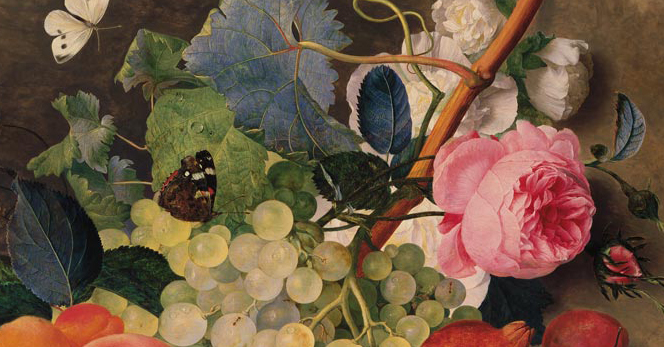
Let me paint you a picture from a time far gone.
Let me take you back to the studio of Jan van Huysum: still-life painter extraordinaire, obsessive collector of botanical marvels, and a man who could make a bunch of flowers look more expensive than your entire bloodline.
It is sometime after noon.
Jan has eaten luncheon, or what passed for luncheon before people invented meal deals and began eating sandwiches over keyboards. A plate sits abandoned nearby. Bread. Cheese. Possibly fruit. Something practical that vaguely says I am too serious an artist to subject myself to proper nutrition while in the zone.
He has returned to the painting he has been working on all morning.
The summer heat is pouring through the open windows with the aggression of an unpaid intern who has finally decided to unionise. His powdered wig has been removed and placed on a stand in the corner, because there are limits to artistic dignity and apparently one of them is sweating into horsehair. His collar is undone. His sleeves are pushed back. The studio smells of crushed greenery, cut stems, oil paint and turpentine.
The flowers are beginning to cook.
Not dramatically. They are not bursting into flames. But the peonies have opened wider since morning, the leaves are releasing their oils into the heat, and somewhere inside the arrangement a stem is quietly giving up on life.
Jan does not notice.
He is locked in.
A man undeterred.
There is a particular fold in the petal of a peony that is refusing to cooperate. It catches the light incorrectly. The shadow is too blunt. The curve is wrong. It looks less like a delicate botanical marvel and more like a piece of ham someone has left near a window.
Unacceptable.
He has painted it once.
Wiped it away.
Painted it again.
Still wrong.
His brow tightens. He scratches the side of his mouth with the back of his thumb, leaving behind a faint streak of pigment, and leans closer to the canvas with the very specific expression of a man whose entire relationship with God has temporarily narrowed to one badly behaved petal.
He mixes another colour.
Raises the brush.
Almost touches the canvas.
And at that exact moment, a butterfly floats through the window.
No announcement. No celestial fanfare. No cherub descending from the ceiling to explain that art history is about to become mildly inconvenient.
It simply drifts into the room on a light breeze, circles once and lands directly on the peony.
The peony.
The petal.
The exact one Jan has been glaring at for the better part of an hour.
For a second, he stares at it.
Then instinct takes over.
He stands, waves it away and sits back down.
Problem solved.
Guest evicted.
Back to work.
Except the butterfly is disinclined to leave.
It takes a slow lap around the studio, passes the vase, flutters beside the window and lands on the top edge of the canvas.
Jan looks up.
The butterfly looks back, presumably without remorse, perhaps with a degree of derision, if not outright contempt.
He shoos it away again.
This time with feeling.
The butterfly departs, takes another lap of the room and returns to the floral arrangement as though the previous two expulsions were merely administrative errors.
Back onto the peony it goes.
At this point our friend Jan has had enough.
He inhales, puts down the palette and begins to rise with the long-suffering fury of a man being publicly undermined by something that weighs less than a paperclip.
And then he stops. Purses his lips.
Because the composition is better.
Annoyingly better.
Somewhere in the back of his skull, he can already hear his father asking what the hell he thinks he is doing. Justus had painted butterflies himself, certainly, but there is a difference between placing an insect within a composition and allowing one to arrive uninvited, point out what is wrong with it and assume creative control.
Jan, absolutely not. It is already over the top. Do not add the butterfly.
Unfortunately, the butterfly is right and appears to be whispering, More is more, you coward.
It occupies a space he had not realised was empty. Its wings create the exact counterweight the arrangement needed. The flowers no longer feel packed into the vase like aristocrats competing for visibility in a group portrait. There is air. Rhythm. Movement. A small interruption that somehow makes the whole thing click into place.
The problem Jan has spent all morning trying to paint his way out of has solved itself.
Not through discipline.
Not through theory.
Not through another painstaking revision of the petal.
Through an insect that entered through the window and refused to take a hint.
This is the point where fate becomes unbearable.
Because Jan now has two choices:
- He can wave the butterfly away and continue defending the composition he intended
- Or he can admit that the butterfly has better instincts than he does
So he puts the brush down.
He wipes his fingers against a cloth.
And he watches.
The butterfly opens its wings.
Closes them.
Opens them again.
The arrangement breathes.
And somewhere in that small movement, Jan van Huysum acquires a rather nasty problem.
Because this is supposed to be a still life.
The clue is in the name.
Still.
Life.
The flowers have been cut. The fruit has been picked. Everything has been removed from the unruly vulgarity of the outdoors and brought inside, where it can be arranged, classified and painted into submission.
In Polish, the genre is called martwa natura.
Dead nature.
A term so cheerful it sounds like something stamped on a municipal storage box.
Part of the fantasy is control.
Nature, but indoors.
Nature, but obedient.
Nature, but unable to crawl away halfway through the sitting.
And now there is a butterfly in it.
Very alive.
Very mobile.
Entirely unimpressed by genre convention.
Worse, the composition is better because of it.
That is the calamity I imagine bothering Jan for the rest of the afternoon.
Not the butterfly itself. The butterfly has already won and is probably off harassing someone else’s roses.
The problem is what it revealed.
This is supposed to be a still life.
And now something has flown into it, moved across it and made it better.
The question is no longer whether the butterfly belongs there.
The question is whether Jan has the nerve to leave it there. 🦋
An Introduction to Schrödinger’s Vase
Still life has an etymological problem.
Or perhaps an international custody dispute.
The name entered common use in the seventeenth-century Netherlands as stilleven: still life, quiet life, motionless life.
English took the Dutch position.
The French went in a rather less optimistic direction with nature morte: dead nature.
The Polish looked at the severed stems, sided firmly with France and arrived at martwa natura.
These are not interchangeable descriptions.
One language says the subject is resting.
The other has pronounced it deceased.
It is essentially the Monty Python dead parrot sketch conducted across European art history, with Poland pointing furiously at the cut stems and insisting that the bouquet is obviously dead, while the Dutch maintain that it is merely pining for the fjords.
Annoyingly, both sides have a case.
The flowers have been cut from their roots. Their access to soil, minerals and any meaningful long-term future has been catastrophically renegotiated.
They are going to die.
But they are not dead yet.
They continue drawing water through their stems. Buds may still open. Petals release scent. Leaves transpire. The arrangement shifts by the hour while apparently sitting there doing absolutely nothing.
So what exactly is inside the vase?
Living nature?
Dead nature?
Or nature caught in the awkward administrative period between the two?
The bouquet is biologically active and compositionally doomed. Alive in the present, dead in the tense through which we are already viewing it.
Hence Schrödinger’s Vase.
The flowers are both alive and dead until someone checks the water.
Memento Mori Had Been Running This Department for Centuries
Before still life became a recognised genre in its own right, European art already had a long-standing fixation with reminding everyone that they were going to die.
This was memento mori: remember that you must die.
The message was rarely subtle.
Skulls.
Extinguished candles.
Hourglasses.
Rotting fruit.
Flowers beginning to wilt.
A musical instrument abandoned after the player has presumably become too deceased to finish the performance.
The symbolism worked through reduction. Each object had a moral assignment.
The skull meant death.
The candle meant time.
The bruised fruit meant worldly pleasure was temporary and therefore spiritually suspicious.
Thank you for attending the sermon. Please leave your jewellery, vanity and cheekbones in the collection box on the way out.
Still life absorbed this vocabulary, but flowers complicated the argument.
A skull is finished.
A peony is not.
The peony is dying, certainly, but it is also opening. It becomes most fragrant, extravagant and visually persuasive after it has already been severed from the structure keeping it alive.
It does not represent death as a completed event.
It performs mortality in real time.
The composition is therefore terminal, but not static. It is changing continuously, even as the painter attempts to hold it still.
The artist cuts nature in order to arrange it, then paints it in order to stop it dying.
A rather extraordinary contradiction.
Nature must first be made mortal before art can attempt to make it immortal.
Meanwhile, the Universe Had Developed Additional Content
Jan van Huysum was painting inside the cultural aftershock of one of the greatest perceptual disruptions in human history.
The telescope had arrived.
Not the sort available now, where you point your phone towards Saturn and an app politely identifies which luminous speck you should pretend to understand. Early telescopes were temperamental tubes of glass, blur and theological inconvenience.
But they worked.
The first practical instruments appeared in the Netherlands at the beginning of the seventeenth century. By 1609, Galileo was pointing increasingly powerful versions towards the heavens, which turned out to be a considerably more dangerous direction than towards an approaching army.
What people saw was awkward.
The Moon was not a flawless, polished sphere. It had mountains, shadows and an uneven surface.
Jupiter was not travelling alone. It had moons of its own.
Cloudy patches in the night sky resolved into fields of stars.
The heavens, previously presented as finished, orderly and serenely comprehensible, abruptly developed texture.
The universe had not changed.
Human eyesight had.
Then we looked in the other direction.
While telescopes stretched consciousness outward, microscopes pushed it inward.
A fly’s eye became architecture.
A plant stem became infrastructure.
A droplet of water turned out to contain an entire population of creatures going about their lives without waiting for humanity to notice.
The world became larger in both directions.
Above, innumerable stars.
Below, innumerable organisms.
Reality had apparently been withholding an indecent amount of information.
The telescope did not merely magnify distant objects. The microscope did not merely enlarge small ones.
Together, they revealed that the visible world was not the complete world.
There was always more happening than the existing frame could contain.
The Butterfly Objects to the Binary
This is where our butterfly returns.
The etymology offers two possibilities:
Still.
Or dead.
Paused.
Or concluded.
The butterfly rejects both answers.
It moves.
It feeds.
It leaves.
It may mate, lay eggs and begin the whole deeply unreasonable procedure again.
Egg.
Caterpillar.
Chrysalis.
Butterfly.
Egg again.
The butterfly is not merely alive.
It is metamorphosis made visible.
The caterpillar disappears into a sealed structure that resembles a small tomb, surrenders its former anatomy and emerges wearing wings.
Very restrained.
Barely metaphysical at all.
This made the butterfly an irresistible symbol of the soul, resurrection and transformation. But it also carried something more disruptive into the still life: a model of existence that was neither still nor terminal.
The flowers are dying.
The butterfly is living.
The butterfly will die.
Its offspring may continue.
Matter changes form. Bodies become other bodies. Life feeds upon life and death becomes material for whatever happens next.
Nature keeps circulating without consulting the terminology beneath the museum label.
So the butterfly does not merely contradict martwa natura by being alive.
It exposes the inadequacy of the choice.
Still or dead?
Neither.
Transforming.
The Telescope and the Butterfly Commit the Same Offence
At first, the telescope and the butterfly seem to belong to entirely different discussions.
One points towards Jupiter.
The other sits on a peony behaving as though it owns the place.
But philosophically, they do the same thing.
They reveal that the established frame is too small.
The telescope looks beyond the visible heavens and finds additional worlds.
The microscope looks beneath visible matter and finds additional life.
The butterfly enters the still life and finds an additional state of being.
Each one reveals that the established frame is too small.
This is the widened consciousness of the Baroque world.
Not a simple abandonment of Christianity. Christian symbolism remained everywhere, occasionally wearing gold leaf and shouting from a ceiling. But it no longer had the intellectual room entirely to itself. Classical philosophy, optics, anatomy, botany and empirical observation were crowding into the conversation.
The butterfly could signify Resurrection, the soul, biological metamorphosis, reproduction, appetite, movement and compositional balance all at once.
The symbol had acquired an entire portfolio.
Reality was no longer delivering one tidy moral message per object. It was operating through layers.
More Is More Because Reality Is More
That is where Baroque excess becomes philosophically interesting.
The older moral diagram depended upon clarity.
A skull means death.
A wilting flower means beauty fades.
An extinguished candle means time is over.
Clean. Legible. Slightly joyless.
But the newly expanded world was proving harder to reduce.
The Moon was imperfect.
Jupiter had satellites.
A drop of water contained life.
An insect could apparently enter a tomb as one creature and emerge as another.
Existence was not behaving like a straight line.
So the compositions stopped behaving like one too.
Van Huysum’s bouquets gather flowers from incompatible seasons into arrangements that could never have existed as a single natural event. The painting is not documenting one vase on one afternoon. It is compressing an entire botanical universe into one impossible moment.
More flowers.
More species.
More seasons occupying the same vase despite having no calendrical business meeting one another.
More fruit.
More insects.
More ripeness.
More decay.
More evidence of death.
More evidence that life was continuing anyway.
The composition expanded because reality had.
This was not merely decorative excess designed to reassure wealthy patrons that they remained wealthy, although it did an excellent job of that too.
It was the aesthetic language of a civilisation discovering that the cosmos had considerably more tabs open than previously suspected.
Restraint can describe a tidy theory.
Abundance may be required to describe reality.
The Cosmic Incident Does Not Get Automatic Approval
This brings us back to Jan and his unsolicited creative consultant.
The butterfly does not belong in the painting simply because it arrived unexpectedly.
Chance is not inherently profound.
Sometimes a coffee stain is merely a coffee stain.
Sometimes the corrupted file is simply corrupted.
Sometimes the universe knocks over your turpentine because gravity remains committed to the bit.
The artist still has to decide.
That is where planning and intuition stop being opposites.
Jan’s discipline created the composition. His knowledge of balance, rhythm, colour and negative space allowed him to recognise what the butterfly changed.
Without training, he sees an insect.
Because of his training, he sees the missing counterweight.
This is where good taste actually lives.
Not in rigid obedience to established rules, and not in treating every random event as a telegram from the divine. Good taste is knowing which rule can be broken without collapsing the world the work has created.
It is the ability to distinguish living excess from visual indigestion.
Chance makes the suggestion. Taste decides whether it stays.
In Jan’s case, fate sends a butterfly through an open window.
The butterfly proposes movement, metamorphosis and a considerably more expansive philosophy of life and death than the painting contained five minutes earlier.
It also balances the peonies.
Very useful creature.
Of course, accepting a cosmic intervention in the privacy of one’s studio is comparatively easy.
Explaining it to the person paying for the canvas is where artistic philosophy suddenly develops a pulse.
Weeks Have Passed
The peonies collapse. The fruit is eaten. The studio is aired out. The butterfly, having detonated a minor philosophical crisis and contributed nothing toward the invoice, has long since disappeared.
The commissioner arrives.
He is a stout, prosperous gentleman with the particular air of someone accustomed to having paintings, chairs and other people arranged according to his specifications. He enters Jan’s studio dressed impeccably, carrying himself with the calm confidence of a man whose opinions have rarely encountered meaningful resistance.
He has come to collect his flowers.
Jan stands before the canvas with his back straight and his nerves slightly frayed.
Because there is a problem.
The gentleman commissioned a floral still life.
He did not commission wildlife.
The butterfly was not discussed. It does not appear in the preparatory agreement. There was no supplementary clause permitting spontaneous acts of nature. Jan has had several weeks to consider this and has concluded that the butterfly remains correct, which is artist language for I will now be forced to defend something I did entirely on instinct.
He grips the edge of the covering.
“The completed work.”
With one controlled movement, he reveals the canvas.
The gentleman studies it.
First the vase.
Then the flowers.
Then the fruit.
He makes a low, satisfied noise. The sort patrons make when a painting looks expensive enough to reassure them they remain wealthy.
Jan exhales.
Too soon.
The gentleman’s eyes narrow.
His gaze moves upward. Stops.
One hand rises. A thick finger extends towards the canvas.
“A… butterfly?”
Jan freezes.
There it is.
The question he has been expecting since the moment he yielded to that infuriating creature.
He could explain the balance of mass and negative space. He could discuss movement, temporality, the intrusion of living nature into a composition built from things already severed from life. He could deliver an impromptu lecture on mortality, beauty and the unstable boundaries of the still-life tradition.
Instead, he chooses the oldest surviving strategy in professional creative work:
Say it confidently and hope the client assumes he is behind the times.
“It balances the composition,” Jan says.
A pause.
“Very au courant.”
The gentleman looks at the butterfly again.
Jan keeps his face completely still.
“Very now,” he adds.
Another pause.
This one lingers.
The gentleman raises his eyebrows, considering the possibility that he is witnessing the birth of a trend and, more importantly, that other wealthy gentlemen may not yet own one.
Then he nods.
Slowly.
Approvingly.
“Quite.”
Jan breathes again.
The painting is accepted. The butterfly survives. The invoice is presumably paid.
And the rest is history.